Dog Supplements in Nigeria: A Practical Buying Guide

Dog ownership in Nigeria has grown fast over the last decade, and pet nutrition has grown with it. But the supplement shelf — online or in a pet store — can be confusing: imported products with unclear labelling, local repackaged stock, and a wide range of prices for what looks like the same thing. This guide walks through how to think about the category, what actually matters when comparing products, and how to avoid the most common ways owners waste money on supplements that don't do much.
Start with why you're looking
"Dog supplements" is a broad category. Before comparing products, it helps to be specific about what you're actually trying to support:
- Mobility and joints — often relevant for larger breeds, senior dogs, or very active dogs.
- Digestion — relevant if your dog has had loose stools, sensitivity to food changes, or general digestive inconsistency.
- Skin and coat — relevant for dullness, dryness, or excessive shedding outside of normal seasonal patterns.
- General daily nutrition — relevant for any dog, as a way of rounding out a standard diet with vitamins and nutrients that aren't always guaranteed in commercial dog food.
A single well-formulated product can often cover more than one of these at once, which matters once you start comparing prices — see our guide to what a K9 multi-benefit supplement actually contains for how that works in practice.
Understanding the dog supplement market in Nigeria
The local market is a genuine mix. Some products are imported directly by verified pet retailers with proper storage and handling. Others move through informal resale channels — social media pages, marketplace listings — where storage conditions, authenticity, and freshness are much harder to verify. Both exist side by side, often at similar price points, which is exactly why it's worth learning to tell them apart rather than assuming price alone signals quality.
A few patterns are worth knowing before you start comparing:
- Price doesn't reliably indicate formula strength. Packaging, brand marketing, and import costs affect price as much as the actual ingredient amounts do. Two products at very different prices can have similar (or very different) ingredient content — the only way to know is to check the label.
- Availability shifts. Because much of the category depends on importation, specific products can go in and out of stock. This is a real practical reason to prioritize sellers with consistent restocking over one-off deals.
- Labelling standards vary. Not every product sold locally lists ingredient amounts per serving. Products that do are meaningfully easier to evaluate than ones that just list ingredient names.
What to check before buying in Nigeria specifically
Importation and storage
Many supplements sold locally are imported, which means shelf life and storage conditions matter more than usual. Check expiry dates directly rather than assuming a product is fresh because it's new to a shop, and be cautious of products that have clearly been stored in direct heat or humidity for extended periods — this matters especially for oil-based ingredients and probiotic blends, both of which are sensitive to temperature.
Ingredient transparency
Products that clearly list ingredient amounts per serving — not just an ingredient list — are easier to evaluate and compare. A label that says "contains glucosamine" without a milligram amount tells you very little; see our note on reading a supplement label properly for what to actually look for.
Where you're actually buying from
Verified sellers with a real storefront, business address, and after-sales contact are worth the small premium over unverified pages, especially for anything your dog will be eating daily. If a seller can't answer basic questions about storage, batch dates, or delivery timelines, that's worth treating as a signal.
Local delivery and support
A supplement is only useful if you can reliably reorder it. Check delivery coverage across Lagos, Abuja, and other major cities before committing to a product long-term — see our Lagos-specific notes on this if that's your primary market. A product you can't consistently get more of isn't a routine, it's a one-off purchase.
The main categories of dog supplements, explained
Joint and mobility support
Built around glucosamine, chondroitin, and MSM, usually together rather than individually. Most relevant for larger breeds, senior dogs, and very active dogs, though it's commonly used earlier as a preventive part of a wellness routine too. Our dedicated joint supplement guide and glucosamine breakdown go into this in more depth.
Digestive support
Centered on a probiotic blend, measured in CFU (colony-forming units) rather than milligrams. Commonly used around food transitions or general digestive inconsistency. See our full probiotic guide for what to look for on a label.
Skin and coat support
Usually built around wild Alaskan salmon oil and antioxidant nutrients. Coat condition is one of the more visible general-wellness indicators, which is part of why this category gets searched for so often. Our salmon oil guide covers sourcing and dosing in detail.
General daily nutrition
A spread of vitamins (commonly C, E, and the B-complex group) and amino acids like taurine, meant to round out a standard diet rather than correct a specific deficiency. See our vitamins guide for which ones come up most often and why.
What affects the price
Cost per jar or pack is a poor comparison on its own — what matters is cost per serving, and how many actual milligrams of active ingredient that serving contains. A cheaper product with a token amount of glucosamine can work out more expensive per effective dose than a pricier one formulated properly. When comparing two products, divide the price by the number of servings, then compare that against the ingredient amounts on each — that's a far more honest comparison than sticker price alone.
A reasonable starting point
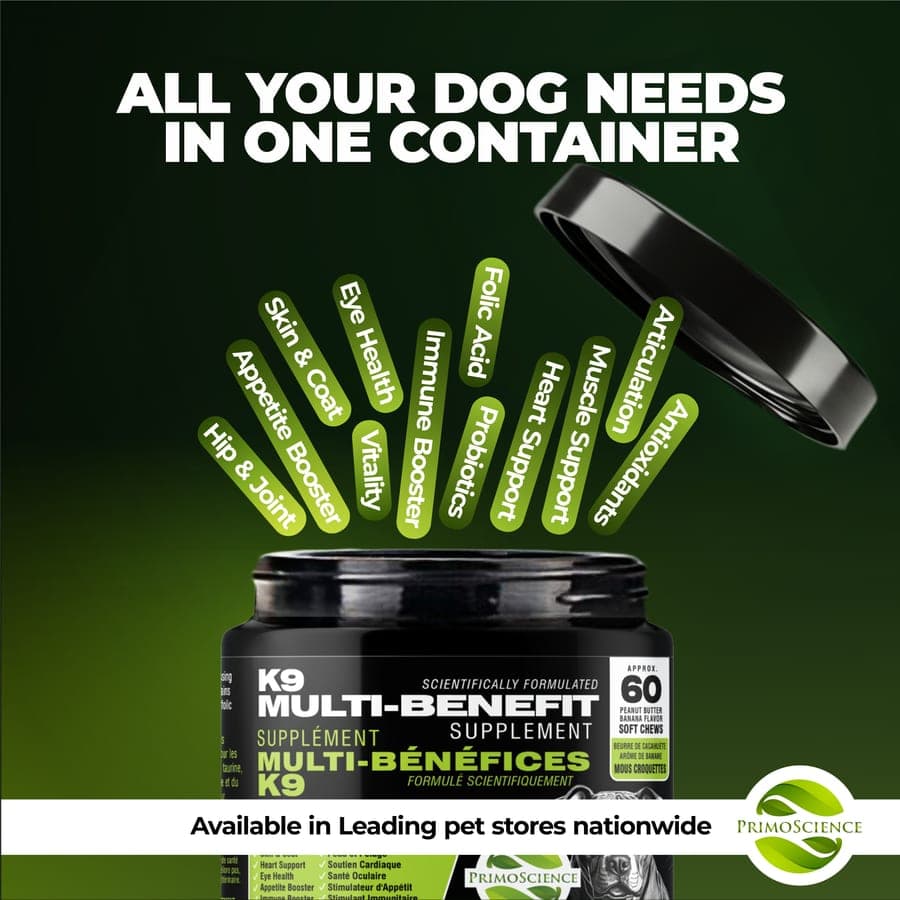
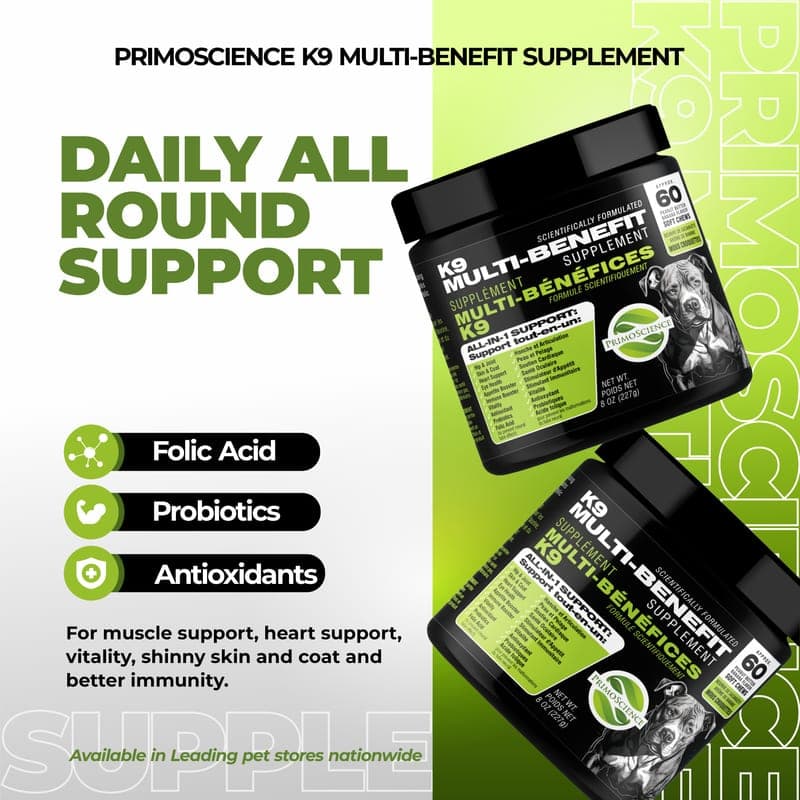
If you're looking for a single product that covers joint support, digestion, skin and coat, and daily nutrition rather than juggling several separate items, PrimoScience K9 Multi-Benefit Supplement is formulated for exactly that — glucosamine, chondroitin, and MSM for joints, a probiotic blend for digestion, wild Alaskan salmon oil for skin and coat, and a full spread of vitamins for everyday nutrition, all in one daily soft chew, with delivery available across Nigeria. Every ingredient and its exact amount is listed on the product facts panel, so there's nothing to take on faith.
For a broader framework on evaluating any product against this same standard, see our guide on finding the best dog supplements in Nigeria.
Whatever you choose, remember that supplements are meant to support a complete and balanced diet — not replace one — and any specific health concern is always worth discussing with a qualified veterinarian first.
Frequently asked questions
There's rarely one clear sign. Owners usually start looking after noticing something specific — stiffness on stairs, a duller coat, inconsistent digestion — or simply because they want to round out a diet that may not be nutritionally complete on its own. If you're unsure whether your dog's diet needs supplementing, a quick conversation with your veterinarian about their current food and any specific concerns is the most reliable starting point.
Imported products aren't inherently a problem, but they add variables that locally-stocked products don't have: longer supply chains, more handling, and more opportunities for poor storage before the product reaches you. Buying from a verified seller who can confirm proper storage and show a clear expiry date reduces most of that risk.
It depends on what's in each product. Giving two separate supplements that both contain glucosamine, for example, can mean unintentionally doubling up on one ingredient while under-dosing another. This is one of the practical reasons multi-benefit formulas exist — a single, clearly labelled product is easier to dose correctly than stacking several. If you're already giving your dog more than one supplement, it's worth checking the labels against each other, or asking your vet.
Nutritional supplements are generally different from medications and typically don't require a prescription. That said, if your dog is currently on any prescribed medication, it's worth checking with your veterinarian before adding a new supplement, simply to rule out any interaction.
This varies by ingredient and by dog, and it's not something a supplement label can honestly promise a fixed timeline for. Nutritional ingredients like glucosamine, probiotics, and omega oils generally work as part of a consistent daily routine rather than producing an immediate change, which is why consistency matters more than any single dose.
Ready to support your dog's daily wellness?
PrimoScience K9 Multi-Benefit Supplement — one daily chew for joints, digestion, skin & coat, and everyday nutrition.