Why Probiotics Matter for Your Dog's Digestion

Digestive issues are one of the most common reasons dog owners start researching supplements — a bout of loose stools, sensitivity every time the food brand changes, or general inconsistency that never quite resolves. Probiotics come up constantly in that search, so it's worth understanding what they actually do, when they're relevant, and what separates a well-formulated probiotic product from a weak one.
What a probiotic blend is
A probiotic blend is a mix of beneficial bacterial strains included in a supplement to provide digestive-support nutrition. The idea is straightforward: a dog's digestive system relies on a balance of bacteria, and a probiotic blend is formulated to support that balance as part of a daily routine.
Understanding CFU counts
Probiotic amounts are usually measured in CFU (colony-forming units) rather than milligrams — this is the standard way to indicate how much active probiotic content a serving actually contains. A higher CFU count isn't automatically "better" in isolation; what matters is that the count is clearly stated and consistent with what's typical for a daily wellness product, rather than left off the label entirely.
How gut bacteria connects to more than digestion
Digestive balance is often discussed in isolation, but it's commonly framed as part of overall wellness rather than a completely separate system — which is part of why probiotic blends are frequently included in broader multi-benefit formulas rather than sold purely as a standalone digestive product. This is a general nutritional framing, not a claim that probiotics treat conditions outside digestion.
When digestive support tends to come up
Dog owners most commonly start looking into probiotics around:
- Food transitions — switching brands or formulas can temporarily affect digestion, and probiotics are commonly used to support the adjustment.
- General digestive inconsistency — irregular stools without an obvious cause.
- After a course of antibiotics, which can affect gut bacteria — though this is exactly the kind of situation worth discussing with a vet directly rather than self-managing with a supplement alone.
- As a standing part of a daily wellness routine, alongside joint, skin and coat, and general nutritional support, rather than only reactively.
Probiotics vs. prebiotics
These two terms get used almost interchangeably in casual conversation, but they describe different things. Probiotics are the live bacterial strains themselves. Prebiotics are a type of fiber that feeds and supports those bacteria, whether from a supplement or from the diet more broadly. A probiotic blend addresses the bacteria directly; prebiotic content supports the environment those bacteria need to function. Knowing the distinction helps when comparing labels that use one term or the other, or both.
Why survivability matters for probiotic quality
A probiotic's journey doesn't end at the CFU count on the label — the strains also need to survive manufacturing, storage, and passage through the digestive system to be useful at all. This is part of why storage conditions matter more for probiotics than for many other supplement ingredients: heat and humidity can degrade live bacterial content well before the expiry date on the packaging. A product that's been sitting in poor storage conditions may list an accurate CFU count for the day it was manufactured while delivering meaningfully less by the time it reaches your dog. This is a practical reason to buy from sellers who can speak to how a product was stored and shipped, not just what the label says.
What to check on a probiotic supplement label
- CFU count per serving — this is the actual measure of probiotic content, not the ingredient name alone.
- Whether it's part of a broader formula or a standalone product — a probiotic blend included as one part of a multi-benefit chew can be a simpler way to cover digestion without adding a separate product to the routine.
- Storage instructions — some probiotic products are sensitive to heat and humidity, which matters for storage in Nigeria's climate specifically.
- Strain information, where available — not every label lists specific strains, but products that do offer more transparency than those that just say "probiotic blend."
Probiotics during food transitions
Switching dog food — whether changing brands, formulas, or moving a puppy onto adult food — is one of the more common triggers for temporary digestive upset, simply because the gut needs time to adjust to a new ingredient profile. Owners often start a probiotic around this kind of transition specifically to support that adjustment period, generally alongside the standard advice of introducing new food gradually over a week or more rather than switching all at once. A probiotic isn't a substitute for a gradual transition; the two work better together than either alone.
Where it fits in PrimoScience K9
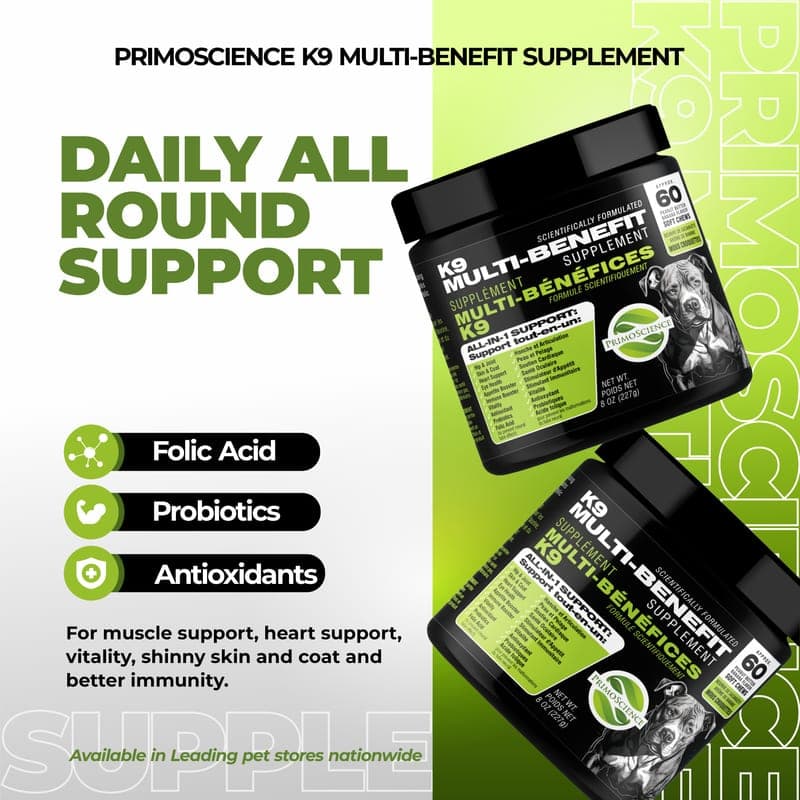
PrimoScience K9 Multi-Benefit Supplement includes a probiotic blend (1B CFU per soft chew) as part of a formula designed to support healthy digestion, alongside joint-support ingredients, wild Alaskan salmon oil, and a full spread of vitamins — see the complete product facts panel for exact amounts.
Probiotic supplements support digestive wellness as part of a routine — they aren't a treatment for diagnosed digestive conditions, persistent vomiting, or significant changes in appetite. Any of those are worth a veterinary visit rather than a supplement adjustment.
Want the full picture of what's included? See the K9 multi-benefit ingredient guide.
Frequently asked questions
Probiotics are live beneficial bacteria strains, while prebiotics are the type of fiber that feeds those bacteria. Some formulas include both, but they're not interchangeable terms — a label listing 'prebiotic fiber' isn't the same as a probiotic blend with a CFU count.
Probiotics are commonly used to support general digestive balance, but ongoing or severe diarrhea is a symptom that should be evaluated by a veterinarian rather than managed with a supplement alone, since it can have a range of underlying causes.
Yes — dog probiotic supplements use strains and dosing formulated for a dog's digestive system, and are generally the more appropriate choice over a human probiotic product. Stick to products formulated and labelled specifically for dogs.
This varies by dog and by the reason for use. Probiotics are generally a daily, cumulative addition to a routine rather than something with an immediate effect, which is part of why consistency matters more than any single dose.
This depends on the specific product and your puppy's age and health status — it's best confirmed directly with your veterinarian rather than assumed from an adult-dog product's labelling.
Ready to support your dog's daily wellness?
PrimoScience K9 Multi-Benefit Supplement — one daily chew for joints, digestion, skin & coat, and everyday nutrition.