Dog Vitamins in Nigeria: What Your Dog Actually Needs
"Does my dog need vitamins if they're already eating dog food?" is one of the most common questions dog owners ask — and it's a fair one. Commercial dog food is formulated to meet baseline nutritional standards, but baseline isn't the same as optimal, especially for dogs with higher activity levels, specific breeds, or diets that vary in quality or storage conditions. This guide breaks down which vitamins actually come up most often in dog nutrition, why the "gap" exists in the first place, and what to check before buying a vitamin supplement in Nigeria.
Which vitamins actually come up most often
Vitamin C
An antioxidant nutrient. Dogs can produce some of their own, but supplementation is commonly included in wellness formulas alongside other antioxidants as part of general nutritional support.
Vitamin E
Another antioxidant nutrient, often included alongside omega oils since the two are frequently paired in nutritional formulas — see our salmon oil guide for how that pairing works.
B-vitamins (B1, B2, B6, B12) and folic acid
Support general metabolic function and are commonly grouped together in daily wellness supplements rather than sold individually, since they tend to work as a group rather than in isolation. This is why you'll usually see the full B-complex listed together on a label rather than a single B-vitamin on its own.
Taurine
Isn't technically a vitamin, but it's an amino acid frequently included in the same "daily nutrition" category, especially in formulas aimed at broad everyday wellness.
Signs owners commonly look into vitamin supplementation
There's no single definitive sign that a dog's diet is falling short, but a few things tend to prompt owners to start researching vitamins: lower energy than usual, a coat that looks duller than it used to, or simply wanting to be proactive about a diet that may not be fully optimal. None of these are diagnostic on their own — they're reasons to ask the question, not conclusions to act on without a vet's input if the concern is persistent or significant.
Why the "gap" exists
Commercial dog food is formulated to a nutritional standard, but factors like ingredient sourcing, processing, and storage can affect how much of that nutritional value actually survives to the bowl. Highly active dogs, working dogs, and dogs on lower-quality or budget food are the groups where a vitamin gap is most commonly discussed by owners and breeders.
A daily vitamin supplement doesn't replace a complete and balanced diet — it's meant to complement one, rounding out nutrition rather than correcting a poor diet.
Vitamins vs. whole food: a common misconception
A frequent assumption is that feeding a premium or "complete" commercial food removes any need to think about vitamins at all. In practice, "complete and balanced" describes meeting a formulated nutritional standard, not necessarily an individually optimized profile for every dog's age, activity level, and health status. Supplementation isn't a correction for bad food — it's a way of accounting for the natural variability between what's on a nutrition label and what actually gets absorbed and used day to day.
Fat-soluble vs. water-soluble vitamins
Vitamins generally fall into two categories that matter for how supplementation should be thought about. Water-soluble vitamins (like the B-complex and vitamin C) aren't stored in the body in large amounts — excess is generally excreted, which is part of why they're commonly included in daily formulas without much concern about over-supplementation at reasonable doses. Fat-soluble vitamins (like vitamin E) are stored in body fat and can accumulate over time, which is why dosing amounts matter more for this category and why stacking multiple products containing the same fat-soluble vitamin is worth avoiding without checking combined totals.
What to look for in a vitamin supplement in Nigeria
- Amounts per serving, not vague ingredient lists — see our guide on reading a supplement label.
- No artificial colours or flavors, since these add nothing nutritionally.
- A format your dog will actually eat consistently — a vitamin supplement only helps if it's part of a routine, not sitting half-finished in a cupboard.
- Appropriate storage, particularly relevant in Nigeria's climate for any product that isn't shelf-stable at higher temperatures.
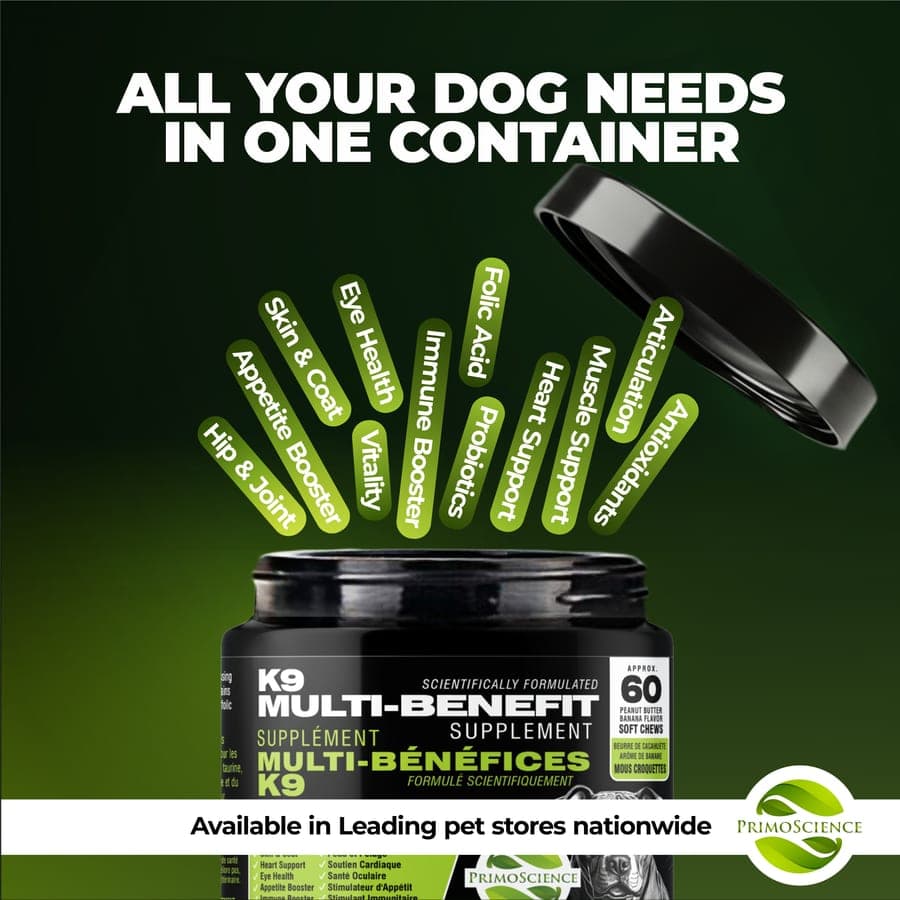
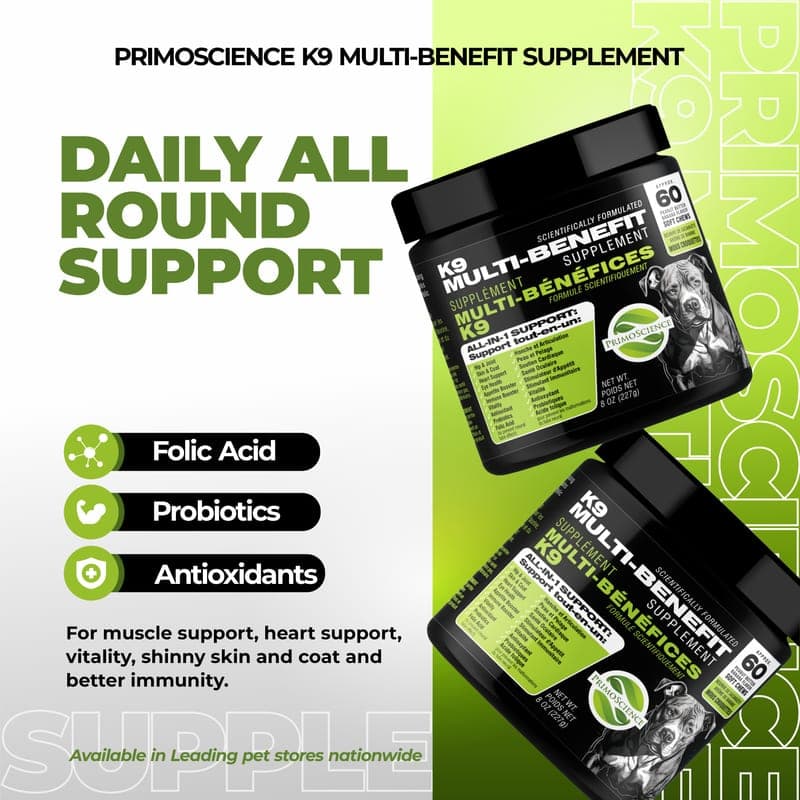
PrimoScience K9 Multi-Benefit Supplement brings vitamin C, vitamin E, a full B-complex (B1, B2, B6, B12), folic acid, and taurine together in one daily soft chew, alongside joint-support and digestive-support ingredients — so daily nutrition isn't a separate step from everything else. See the full ingredient system for how it all fits together.
If your dog has a specific deficiency concern, that's a conversation for your veterinarian rather than a supplement label — vitamins support general wellness, they don't diagnose or treat anything on their own.
Building vitamins into an existing routine
If your dog is already on a feeding schedule, the simplest way to keep a vitamin supplement consistent is attaching it to a meal your dog already eats reliably, rather than treating it as a separate task. This is part of why format matters as much as formulation — a chew that's easy to give alongside food tends to stick as a habit far more reliably than a powder or liquid that requires extra preparation each time.
Frequently asked questions
This isn't something to do without checking with your veterinarian first. Human vitamin formulations are dosed for human body weight and can include ingredients or amounts that aren't appropriate for dogs. A product formulated and dosed specifically for dogs is the safer default.
Commercial dog food is generally formulated to meet baseline nutritional standards, but 'meets a standard' and 'optimal for this specific dog' aren't the same thing. Factors like ingredient quality, processing, and storage can all affect how much of that formulated value actually reaches the bowl. If you're unsure, your veterinarian can review your dog's current diet and flag any real gaps.
Yes, over-supplementing certain vitamins is possible, particularly with fat-soluble vitamins that the body stores rather than excretes. This is one of the reasons dosing amounts on a label matter, and why stacking multiple vitamin products without checking overlap isn't a good habit. If your dog is already on a vitamin-inclusive supplement, avoid adding a second one without checking the combined amounts.
Puppies have different nutritional needs during growth, and puppy-specific commercial food is typically formulated with that in mind. Supplement needs can differ too. This is a conversation worth having directly with your veterinarian rather than assuming an adult-dog product applies the same way.
Nutritional supplementation is generally a slow, cumulative process rather than something with an immediate visible effect, and how quickly (or whether) you notice anything varies by dog. Consistency matters more than any single dose, which is part of why sticking to a daily routine is the practical priority.
Ready to support your dog's daily wellness?
PrimoScience K9 Multi-Benefit Supplement — one daily chew for joints, digestion, skin & coat, and everyday nutrition.