K9 Multi-Benefit Supplement: What's Inside and Why It Matters

Most dog owners don't set out to buy five different supplements. It usually happens gradually: a joint chew after the vet mentions stiffness, a fish oil capsule for a dull coat, a probiotic sachet after a bout of an upset stomach. A year later, the cabinet is full, the dosing schedule is confusing, and half the products are half-used.
A K9 multi-benefit supplement is built to solve exactly that problem — one daily product formulated to cover several areas of everyday wellness at once, instead of asking you to manage a separate product for each one. This guide covers what the term actually means, how to read a label properly, and the mistakes worth avoiding when comparing products.
What "multi-benefit" actually means
The term gets used loosely, so it's worth being specific. A genuine multi-benefit formula generally brings together a few distinct categories of ingredients in a single serving:
- Joint-support ingredients — commonly glucosamine, chondroitin, and MSM, which are frequently included together in nutritional formulas aimed at supporting joint health and mobility. Our joint supplement guide covers this category in depth.
- Omega-rich oils — such as wild Alaskan salmon oil, included as part of a broader nutritional formula and commonly tied to skin and coat wellness. See our salmon oil guide.
- A probiotic blend — providing digestive-support nutrition rather than targeting one specific symptom. Our probiotic guide explains what to check on the label.
- Core vitamins and nutrients — typically a spread of B-vitamins, vitamin C, vitamin E, folic acid, and taurine, rounding out daily nutritional support. See our vitamins guide.
If a product only lists one or two of these categories, it's a single-purpose supplement with a multi-benefit label on it — worth checking before you buy.
Why multi-benefit formulas exist
The case for a multi-benefit product isn't purely convenience, though that's a real part of it. It's also about consistency: a supplement only does anything useful if it's actually given daily, and a dosing routine with one product is far easier to keep up than a routine spread across three or four. There's also a cost angle — buying four separate single-purpose products, each with its own packaging, shipping, and margin, is usually more expensive than one product formulated to cover the same ground.
The trade-off is that a multi-benefit formula has to actually deliver meaningful amounts across each category. A product that lists ten ingredients but doses each one at a fraction of what a single-purpose product would use isn't necessarily giving you more — it may just be giving you less of everything. This is exactly why label-reading matters more with multi-benefit products than with single-purpose ones.
How to actually read the label
Amounts, not just names
A label that lists "glucosamine" without an amount per serving tells you very little. Look for milligram (or IU/mcg, or CFU for probiotics) amounts per chew, not just an ingredient list. This is the single most useful habit for evaluating any supplement, multi-benefit or not.
What's left out
Artificial colours, artificial flavors, and unnecessary fillers add nothing nutritionally. A short, clean "does not contain" list is usually a good sign — it suggests the formulation prioritized the active ingredients over padding.
Serving size math
Check how many chews make up a full daily serving and how far a jar actually stretches — this affects the real cost per month, not just the sticker price. A jar that looks cheaper per unit can work out more expensive if the daily serving size is larger.
Common mistakes when comparing multi-benefit products
A few patterns come up repeatedly when owners compare products side by side:
- Comparing price without adjusting for serving count. A larger jar at a higher price can still be cheaper per day than a smaller, cheaper-looking one.
- Assuming a longer ingredient list means a stronger formula. More listed ingredients doesn't automatically mean more of each — check the amounts, not the count.
- Not checking what's excluded. Two products can look similar on active ingredients but differ meaningfully on fillers, artificial colours, or flavors.
Multi-benefit vs. targeted single-purpose: which to choose
There's no universal answer — it genuinely depends on your dog. If your dog has one clear, specific need (say, a vet-flagged digestive sensitivity and nothing else) a targeted single-purpose product dosed more heavily in that one area might make more sense than a broader formula. If your dog's needs span more than one category, or you're supplementing proactively as part of general daily wellness rather than addressing one specific issue, a well-formulated multi-benefit product is usually the simpler and more cost-effective route. The deciding question is less "which category is better" and more "what does my dog actually need right now" — the same starting point covered in our broader Nigeria buying guide.
Where PrimoScience K9 fits
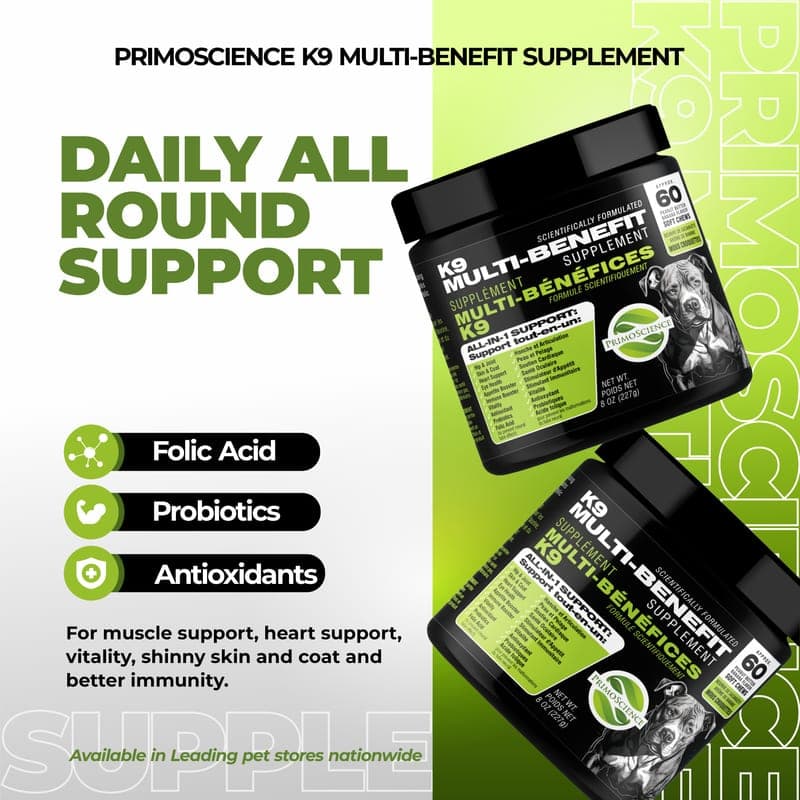
PrimoScience K9 Multi-Benefit Supplement was formulated around this exact idea: one daily soft chew combining glucosamine, chondroitin, and MSM for joint support, wild Alaskan salmon oil, taurine, a probiotic blend, and a full spread of vitamins (C, E, B1, B6, B2, B12, and folic acid) — without artificial colours, artificial flavors, or unnecessary fillers.
Every ingredient and its exact amount per chew is listed on the product facts panel, so you can check it against whatever you're currently feeding before switching, using the same evaluation approach described above.
As with any supplement, it's formulated to support your dog's everyday wellness routine, not to diagnose, treat, cure, or prevent any condition — for anything specific to your dog's health, a conversation with your veterinarian is always the right first step.
Ready to see the full ingredient breakdown? Check current pricing and availability.
Frequently asked questions
It means the formula combines ingredients from more than one wellness category — typically joint support, digestive support, skin and coat, and general nutrition — in a single daily serving, rather than covering just one of those areas. The word alone isn't regulated, so it's worth checking the actual ingredient list against the categories, not just trusting the label.
Not automatically — it depends on the formula. The practical advantages are simpler dosing, one product to remember instead of several, and avoiding accidentally doubling up on an ingredient that appears in more than one separate product. The trade-off is that a multi-benefit formula needs to be checked carefully to confirm it actually contains meaningful amounts across each category, not just a token amount of several ingredients.
There's no fixed number — what matters is whether the ingredients present are dosed meaningfully and whether they map to real categories (joint, digestive, skin/coat, general nutrition) rather than being padded with a long list of trace additions that don't add up to much.
No. Supplements, multi-benefit or otherwise, are formulated to support a complete and balanced diet, not replace one. They round out nutrition; they aren't a substitute for proper daily feeding.
PrimoScience K9 Multi-Benefit Supplement is our own product, formulated around this exact multi-benefit approach — but 'multi-benefit supplement' as a category term also applies more broadly to any product built the same way. This guide is written to help you evaluate the category generally, not just our formula specifically.
Ready to support your dog's daily wellness?
PrimoScience K9 Multi-Benefit Supplement — one daily chew for joints, digestion, skin & coat, and everyday nutrition.